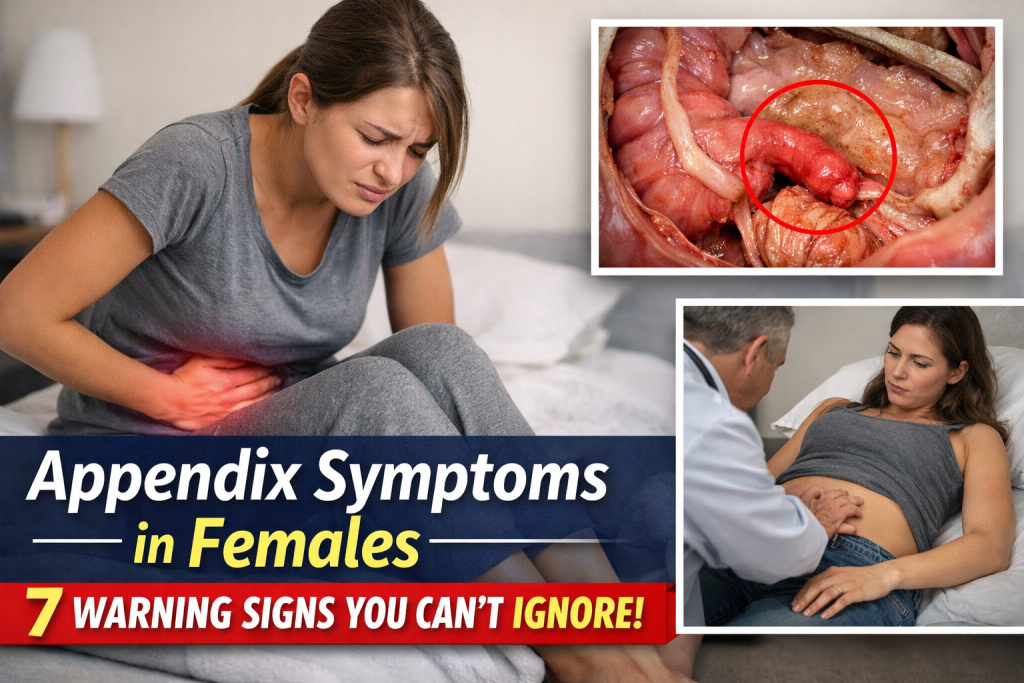
Appendix Symptoms in Females: 7 Warning Signs of Appendicitis You Should Not Ignore
Appendicitis is one of the most important causes of sudden abdominal pain that should never be brushed off. It happens when the appendix becomes inflamed, and without prompt treatment it can lead to serious complications such as rupture, infection inside the abdomen, or an abscess. Major medical sources emphasize that appendicitis is a medical emergency and that quick evaluation matters.
When people search for “appendix symptoms in females,” what they usually want to know is whether appendicitis looks different in women. The most accurate answer is this: the core symptoms are generally the same, but appendicitis can be harder to recognize in females because pain in the lower abdomen and pelvis may overlap with menstrual pain, ovulation pain, urinary issues, ovarian cysts, pelvic inflammatory disease, or ectopic pregnancy. That overlap is one reason diagnosis can be more complicated.
That is why the most useful approach is not to think in terms of “female-only appendicitis symptoms,” but to understand the warning signs that matter most, how they may be confused with other pelvic conditions, and when not to wait.
What is appendicitis?
Appendicitis is inflammation of the appendix, a small finger-shaped pouch connected to the colon on the lower right side of the abdomen. In many cases, the problem begins when the opening of the appendix becomes blocked, which can lead to swelling, infection, and pus buildup. If treatment is delayed, the appendix can burst and spread infection through the abdomen.
1. Abdominal pain that starts vaguely and then shifts
The most classic appendicitis symptom is abdominal pain that begins near the belly button and then moves lower and to the right. It often starts as a vague ache and becomes more focused, sharper, and more intense over several hours. It may also come on suddenly and wake someone from sleep.
In females, this symptom can be easy to second-guess. Some women assume the pain is period-related, ovulation pain, digestive upset, or a bladder problem. But appendicitis pain usually has a worsening pattern rather than a familiar cyclical pattern. It tends to feel more persistent, more localized over time, and more alarming than ordinary cramps.
It is also important to know that the location is not always perfectly textbook. Mayo Clinic notes that the pain site can vary depending on the position of the appendix, and in pregnancy the pain may feel higher in the abdomen because the appendix is displaced upward.
2. Pain that gets worse when you move, cough, walk, or ride over bumps
Appendicitis pain is often aggravated by motion. Walking, coughing, sneezing, taking deep breaths, or even small jolts can make it feel worse. This happens because the inflamed area becomes more sensitive as irritation spreads.
That detail matters because ordinary menstrual cramps, bloating, or mild stomach upset do not usually create the same steadily intensifying “every movement hurts more” pattern. If abdominal pain is becoming more severe with movement rather than easing with rest, that is a more urgent signal.
3. Nausea, vomiting, and loss of appetite
Appendicitis commonly causes loss of appetite along with nausea and sometimes vomiting. These symptoms often show up early and may appear around the same time as the pain intensifies. NIDDK, Mayo Clinic, Cleveland Clinic, and MedlinePlus all list appetite loss, nausea, and vomiting among the typical symptoms.
This is another reason appendicitis can be confused in women. Nausea and abdominal discomfort may be mistaken for a stomach bug, food poisoning, PMS, or early pregnancy. But when nausea comes with worsening abdominal pain, especially pain that shifts toward the right lower abdomen, appendicitis needs to be considered.
4. Low-grade fever or feeling suddenly unwell
A low-grade fever can appear as appendicitis progresses. Mayo Clinic lists low-grade fever as a common symptom that may rise as the illness worsens, and Cleveland Clinic notes that fever may reflect increasing inflammation or spreading infection.
Not everyone gets a fever right away, so the absence of fever does not rule appendicitis out. But abdominal pain plus fever, nausea, and loss of appetite is a combination that deserves prompt medical evaluation, especially if the pain is getting worse hour by hour.
5. Changes in bowel habits, bloating, or trouble passing gas
Appendicitis can also come with digestive changes. Official sources list constipation, diarrhea, bloating, swelling of the abdomen, inability to pass gas, or the feeling that a bowel movement might relieve discomfort.
This is where many people get misled. They assume the problem is constipation or trapped gas and wait it out. But appendicitis is not just a “stomach issue.” If bowel changes are happening alongside worsening abdominal pain, nausea, or fever, that raises the level of concern. A swollen or distended abdomen may be a later and more serious sign.
6. Urinary or pelvic symptoms that make it feel like something else
Some women with appendicitis describe pelvic pressure, urinary urgency, or discomfort that feels more like a bladder issue than a bowel emergency. Cleveland Clinic notes that appendicitis can sometimes create urinary symptoms, including feeling like you need to urinate more often or more urgently, when nearby nerves are irritated.
This matters because lower abdominal pain in females sits close to the urinary tract and reproductive organs. NIDDK notes that doctors may use urinalysis to help rule out bladder infection or kidney stones, and pelvic causes also have to be considered.
In real life, appendicitis can be confused with a UTI, ovarian cyst, ectopic pregnancy, pelvic inflammatory disease, or other pelvic problems. That is why women of reproductive age often need a broader evaluation than people expect.
7. A general feeling that something is wrong
Not every case begins dramatically. Some people mainly notice fatigue, malaise, restlessness, or an unusual sense that they cannot get comfortable. Cleveland Clinic specifically lists malaise as a possible symptom and describes the general “sick” feeling many people notice as appendicitis develops.
This symptom is not specific on its own, but it becomes more meaningful when it appears with abdominal pain, appetite loss, nausea, or fever. Many serious abdominal conditions do not announce themselves with a single unmistakable sign. Sometimes it is the combination and the progression that matters most.
Why appendicitis is often harder to recognize in females
The key issue is overlap. Lower abdominal and pelvic pain in females can come from the digestive system, urinary system, or reproductive organs. Conditions like ovulation pain, ovarian cysts, pelvic inflammatory disease, or ectopic pregnancy may feel similar enough at first that self-diagnosis becomes unreliable.
Pregnancy can complicate the picture further. Mayo Clinic notes that in pregnancy the appendix may sit higher, so the pain may not be felt in the usual lower-right location. NIDDK also notes that doctors often use ultrasound first in children, young adults, and pregnant women, and pregnancy testing is part of evaluation for women.
The takeaway is simple: if pain feels unusual, progressively worse, and not like your normal cramps or pelvic discomfort, do not assume you know what it is.
When to get emergency help
Seek urgent medical care right away if you have:
- pain that is severe or rapidly worsening
- pain that shifts to the lower right abdomen
- pain with nausea, vomiting, or fever
- marked tenderness when the abdomen is touched
- a swollen or bloated abdomen
- abdominal pain so bad that you cannot move comfortably or find a position that feels tolerable
Appendicitis should not be watched at home for “another day or two” once the symptoms look concerning. Quick evaluation lowers the chance of rupture and other complications.
How doctors tell the difference
Doctors diagnose appendicitis by combining your symptom history with a physical exam, lab testing, and imaging. NIDDK says the workup may include blood tests, urinalysis, pregnancy testing for women, and imaging such as ultrasound, MRI, or CT depending on the situation.
That is especially important in females because the goal is not just to “confirm appendicitis,” but also to rule out other urgent pelvic and abdominal conditions that can mimic it.
The most important appendix symptoms in females are not entirely different from appendicitis symptoms in anyone else. The major warning signs are worsening abdominal pain, especially pain that begins near the belly button and shifts rightward, pain that gets worse with movement, nausea, vomiting, loss of appetite, low-grade fever, bowel changes, and sometimes urinary or pelvic symptoms.
What makes the topic more complicated in women is the number of other conditions that can look similar. Period pain, ovulation pain, ovarian problems, urinary issues, and ectopic pregnancy can blur the picture. That is exactly why worsening abdominal pain should not be self-diagnosed at home.
If the pain is escalating, localized, or paired with nausea, fever, vomiting, or abdominal tenderness, it is time for urgent medical care.